
EFCA and Italian Coast Guard host ECGFF workshop on Multipurpose Maritime Operations and innovative technologies in Chioggia

Submitted by Ioana.Hartescu on

On 11–12 March 2026, the European Fisheries Control Agency (EFCA) and the Italian Coast Guard, under the Italian Chairmanship of the European Coast Guard Functions Forum (ECGFF), jointly organised a workshop in Chioggia, Italy on the implementation of Multipurpose Maritime Operations (MMOs) and the use of innovative technologies in fisheries control activities.

The event brought together representatives from national authorities responsible for coast guard functions, alongside the EU agencies cooperating in this field: EFCA, the European Maritime Safety Agency (EMSA) and the European Border and Coast Guard Agency (Frontex). The workshop provided a platform for experts to exchange operational experience and discuss how emerging technologies can support fisheries control and broader maritime surveillance activities.

From technological capabilities to operational implementation

Since 2021, EFCA and the ECGFF have jointly organised a series of thematic workshops dedicated to the role of innovative technologies in coast guard functions, with a particular focus on fisheries monitoring, control and surveillance. Earlier editions explored available technologies, their evidentiary use, and their suitability for operational purposes.

Building on these discussions, the 2026 workshop focused on the practical implementation of technologies within Multipurpose Maritime Operations. MMOs allow national authorities to address several coast guard functions simultaneously, combining activities such as fisheries control, maritime safety, environmental protection and law enforcement through coordinated operational frameworks.

Sharing operational experiences and technological developments

Throughout the two-day programme, participants reviewed the current state of play of MMOs in Europe and shared operational experiences from Member States. Discussions explored how innovative tools, including geospatial intelligence and emerging surveillance technologies, can enhance the effectiveness of monitoring, control and inspection activities at sea.

Participants also examined potential challenges linked to the integration of new technologies into operational settings, identifying areas where innovation could bring added value to future maritime operations.

Strengthening cooperation across the European coast guard community

The workshop reaffirmed the importance of cooperation between national authorities and EU agencies in addressing evolving maritime challenges. By bringing together operational practitioners, technical experts and policymakers, the event contributed to strengthening cross-sector and cross-border cooperation within the European coast guard community.

Through initiatives such as this workshop, EFCA and its partners continue to support the development of more coordinated and effective maritime operations across Europe.
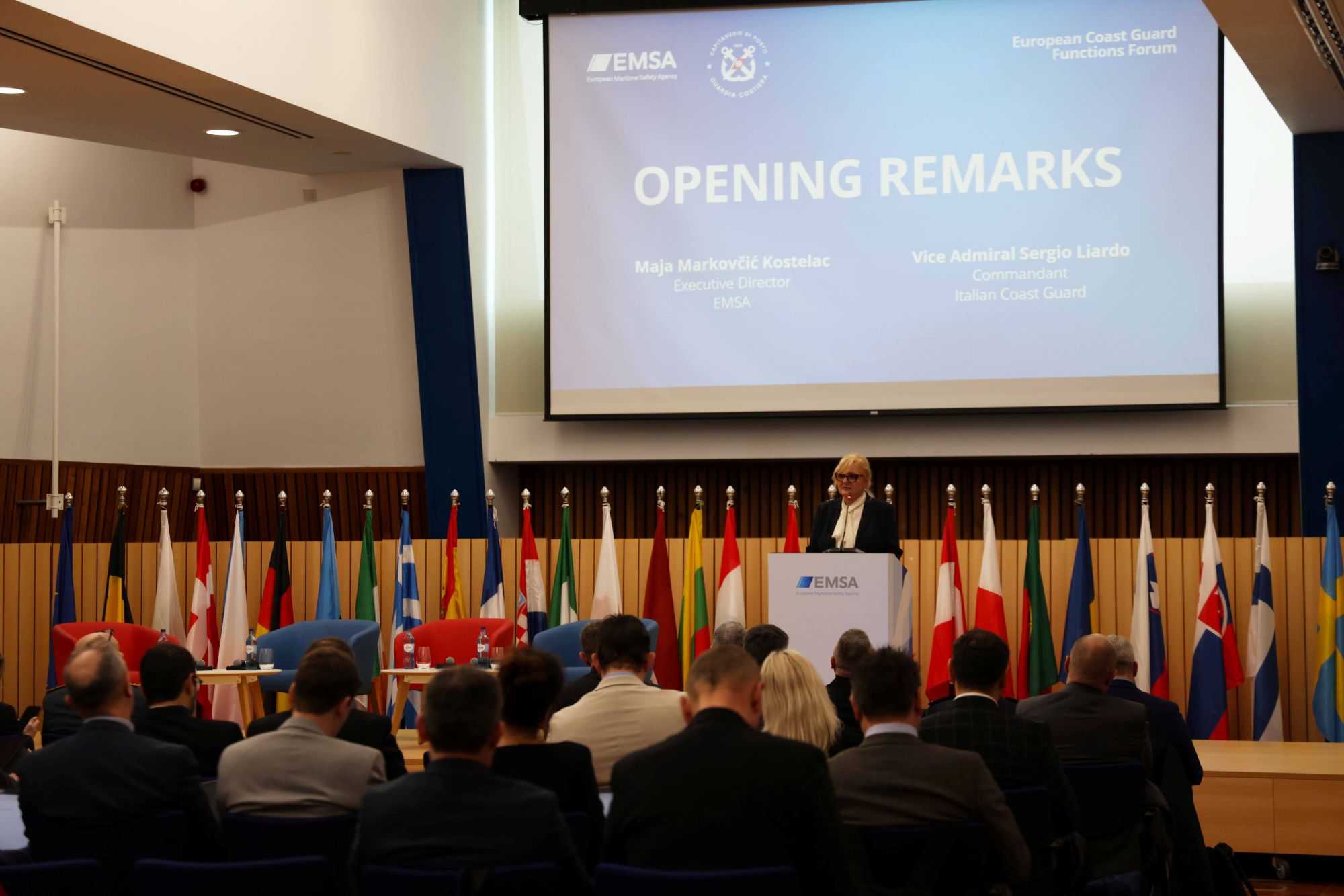
EMSA hosts ECGFF thematic workshop on evolving maritime challenges

Submitted by Ioana.Hartescu on

On 11-12 February, EMSA hosted the first thematic workshop of the European Coast Guard Functions Forum (ECGFF) programme for 2026 at its premises in Lisbon. Organised in conjunction with the Italian Chairmanship of the ECGFF, the workshop provided a forum to exchange perspectives and strengthen trust-based cooperation on coast guard functions.

Entitled “Maritime challenges: from addressing geopolitical shifts to capacity building in support of coast guard operations”, the one-and-a-half-day event brought together representatives from Member State administrations with coast guard responsibilities, the European Commission, ESA, EMSA, EFCA and Frontex to discuss current and emerging challenges in the maritime domain and their implications across Europe.

The programme addressed a range of topics shaping today’s maritime operating environment, including geopolitical developments and hybrid threats, the decarbonisation of maritime transport, the use of advanced technologies for maritime surveillance, and the growing importance of capacity building and training.

An opening panel set the scene by inviting panellists to outline key maritime challenges, the actions being taken at national and European level, and lessons learned that could be shared more widely. Speakers included representatives from the European Commission (DG MOVE), national maritime and transport administrations, and coast guard authorities.

Subsequent panels examined the operational and safety implications of maritime decarbonisation, as well as  the opportunities and challenges linked to maritime surveillance technologies. Bringing together Member State authorities, EU Agencies, and training and technical experts, the discussions highlighted the value of combining operational, regulatory and technical perspectives.

Dedicated sessions highlighted how EMSA, EFCA, and Frontex support national authorities within their respective mandates. Presentations covered surveillance services, underwater and aerial capabilities, and multipurpose maritime operations, placing agency support in the wider context of joint European efforts alongside national initiatives. 

The workshop concluded with a session on capacity building, focusing on trainer development and the use of e-learning and blended learning solutions as enablers of consistent, inclusive and sustainable training across administrations.

opening remarks

Performance Assessment Methodology for Document Inspection System (PAM4DIS)

Submitted by laura.rosenber… on
Reference
Frontex 43
Aims/Objectives/Audience

The Performance Assessment Methodology for Document Inspection System (PAM4DIS) toolkit provides Member States a means to evaluate a Document Inspection System (DIS) as part of an operational border check system. By applying the methodology described, there is an enormous potential to prevent threats to internal security arising from shortcomings or failings in document security. 

Contact: HoU.Academy@frontex.europa.eu 

Link: https://www.frontex.europa.eu/assets/Publications/Research/Performance_Assessment_Methodology_for_DIS_-_Toolkit.pdf

Frontex Annual Report on Training Needs Assessment

Submitted by laura.rosenber… on
Reference
Frontex 42
Aims/Objectives/Audience

This report outlines the findings of the Training Needs Assessment (TNA) conducted by the European Border and Coast Guard Agency (Frontex) each year. It consolidates feedback from internal entities and EU Member States/SAC / cooperative EU agencies to identify training priorities and optimize the use of resources.
The document delivers a comprehensive view of requested courses, new training proposals, and data-driven recommendations for the development of the Annual Training Plan. It emphasizes a transparent and strategic approach to addressing operational needs through structured training offers.

Contact: HoU.Academy@frontex.europa.eu 

EBCG Academy Training Catalogue

Submitted by laura.rosenber… on
Reference
Frontex 41
Aims/Objectives/Audience

The EBCG Training Catalogue indicates the learning services that will be developed and delivered during the current year  and, depending on the needs identified , eligible to be delivered also during the following year.

Contact: HoU.Academy@frontex.europa.eu 

Course on Fundamental Rights for Multipliers
Institution
Language
English
Type
European course on examination of breeder documents
Institution
Language
English
Type
Course on Facial Features for Impostors detection
Institution
Language
English
Type